Agentic AI
Nov 13, 2026
s
sndevBuild an Autonomous Deep Research Agent | End-to-End Agentic AI Project | Part 1
“Explore the architecture behind an Autonomous Deep Research Agent built with LangGraph, FastAPI, Gemini/Groq, Tavily, ArXiv, and MongoDB. 🚀”
1. The Core Idea: Why Single-Prompt LLMs Fail at Research
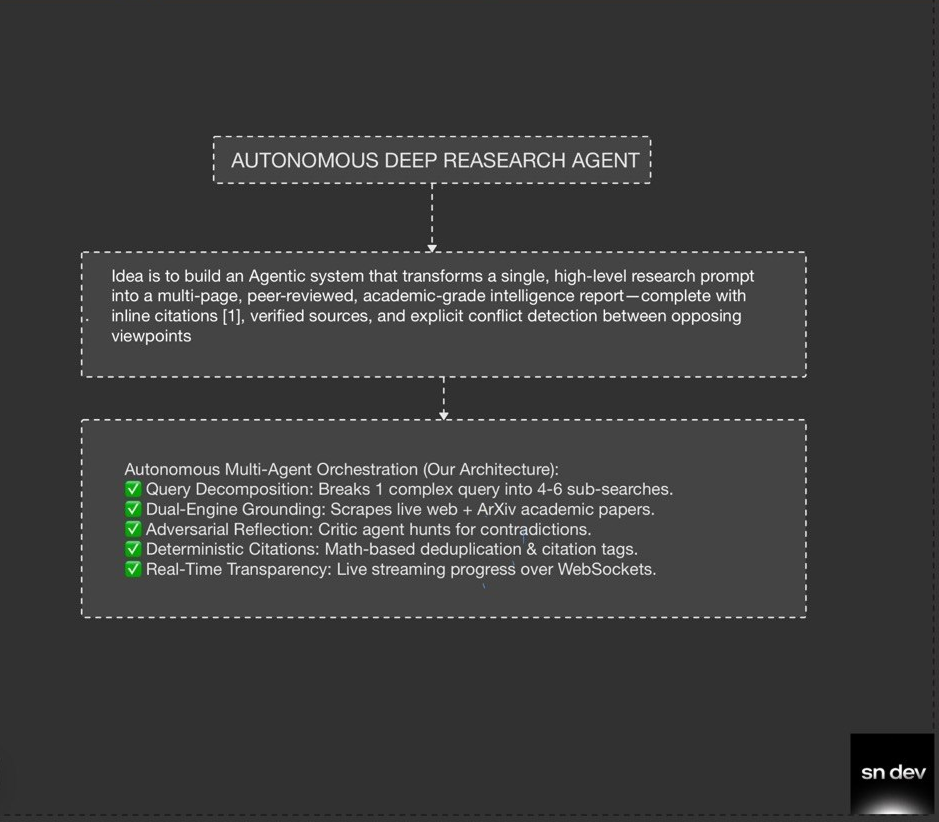
If you ask a frontier model (like GPT-4, Claude, or Gemini) to write an in-depth, 20-page technical research paper, you encounter the "One-Shot" Trap:
Shallow Synthesis: The model generates a generalized 500-word overview rather than an exhaustive multi-source investigation.
Hallucinated Citations: It invents non-existent URLs, authors, and dead DOI links.
Zero Fact-Checking: It cannot cross-examine conflicting statistics or detect contradictions between competing sources.
Why? Because large language models are autoregressive next-token predictors. Confined to a single prompt, an LLM cannot plan, browse dozens of web pages, query academic repositories, or critique its own findings.
The Solution: Agentic Orchestration.
Real research requires mimicking human analytical behavior through specialized agent decomposition:
Planning: Decomposing a complex topic into targeted sub-questions.
Execution: Gathering intelligence from both live web and academic preprint indices.
Adversarial Critique: Hunting for contradictions and benchmark discrepancies between sources.
Grounded Writing: Synthesizing an academic-grade report with verified inline citations (
[1],[2]).
2. Main System Architecture
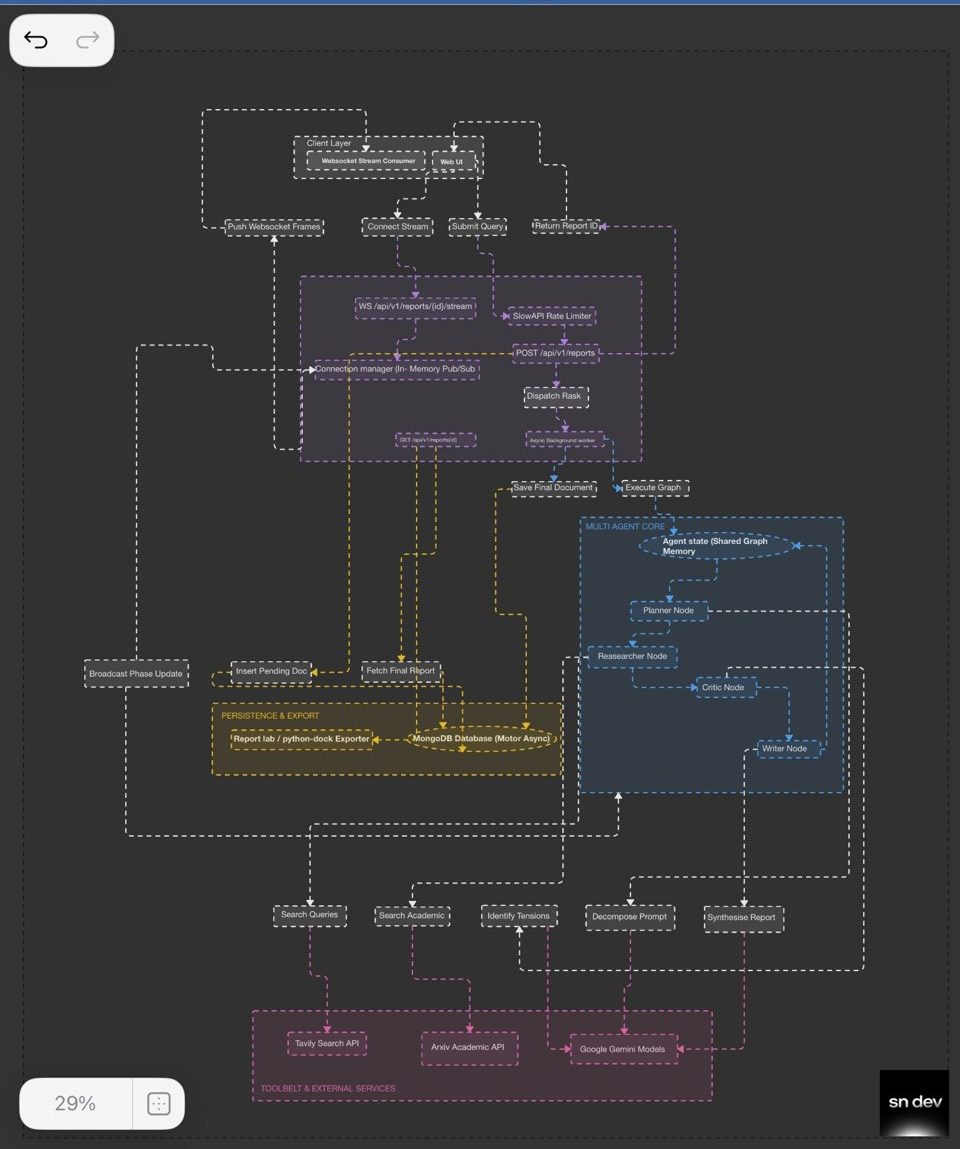
To turn this multi-agent concept into a scalable, real-world application, we need a robust full-stack architecture that supports asynchronous background execution and real-time streaming:
Client Layer (Next.js / Streamlit): Provides an interactive research console, live stage indicators, interactive citation cards, and one-click PDF/Markdown export.
API & Gateway Layer (FastAPI): Enforces SlowAPI rate-limiting (financial firewall against API spam), dispatches non-blocking async background workers, and manages two-way WebSocket communication.
Agentic Brain (LangGraph): Models our multi-agent workflow as a cyclic state machine with strict typed state transitions.
External Grounding Layer: Live web scraping via Tavily, peer-reviewed academic papers via ArXiv, and high-speed inference via Groq (Llama 3.3 70B) and Google Gemini.
Persistence Layer (MongoDB): Asynchronous document storage (via Motor) handling complex nested reports, citations, and conflict metadata.
3. The 5 Core Modules Under the Hood
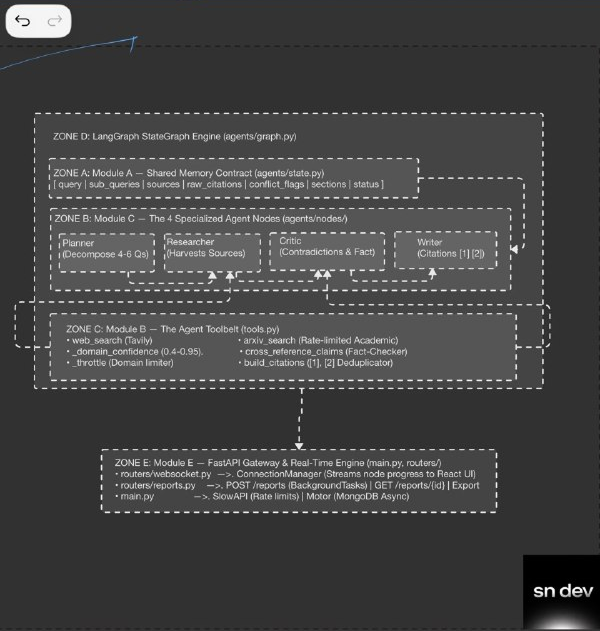
Our backend is organized into 5 decoupled, testable modules:
Module A: The Shared Memory Contract (agents/state.py)
Agents don't pass messy strings back and forth. They read and write to a centralized, typed state—the "shared backpack" containing the original query, generated sub-queries, collected sources, deduplicated citations, and detected conflict flags.
Module B: The Grounding Toolbelt (tools.py)
Provides deterministic tools so agents never rely purely on model memory:
Tavily Web Search: Clean, markdown-parsed search results.
ArXiv Academic Search: Scientific preprints with an asynchronous thread-pool runner and a strict 5-second interval throttle.
Domain Confidence Scorer: Algorithmic trust scoring (
.edu/.gov/arxiv.org→\rightarrow→ 0.95 vs. spam blogs →\rightarrow→ 0.40).Fact Checker & Citation Builder: Deduplicates URLs and maps verified citation tags (
[1],[2]).
Module C: The 4 Specialized Agent Nodes (agents/nodes/)
Planner (
planner.py): Decomposes the research prompt into 4 to 6 discrete sub-queries.Researcher (
researcher.py): Executes search tools, gathers sources, and ranks them by confidence score.Critic (
critic.py): Acts as an aggressive referee, deliberately hunting down benchmark discrepancies, opposing timelines, and conflicting statistics between sources.Writer (
writer.py): Synthesizes verified sources and conflict flags into an analytical report with structured sections and inline numerical citations.
Module D: LangGraph Orchestrator (agents/graph.py)
Compiles the nodes into an executable StateGraph and executes via .astream(), allowing the engine to intercept state transitions and fire real-time updates.
Module E: FastAPI Gateway & Real-Time Engine (routers/)
Implements an asynchronous fire-and-stream pattern:
POST /reportsinserts a skeletonPENDINGrecord in MongoDB, dispatches the agent to an async background worker, and returns thereport_idin under 50ms.WS /reports/{id}/streamestablishes a real-time WebSocket connection to broadcast live progress updates directly to the UI.
4. Application Flow: The Request Lifecycle
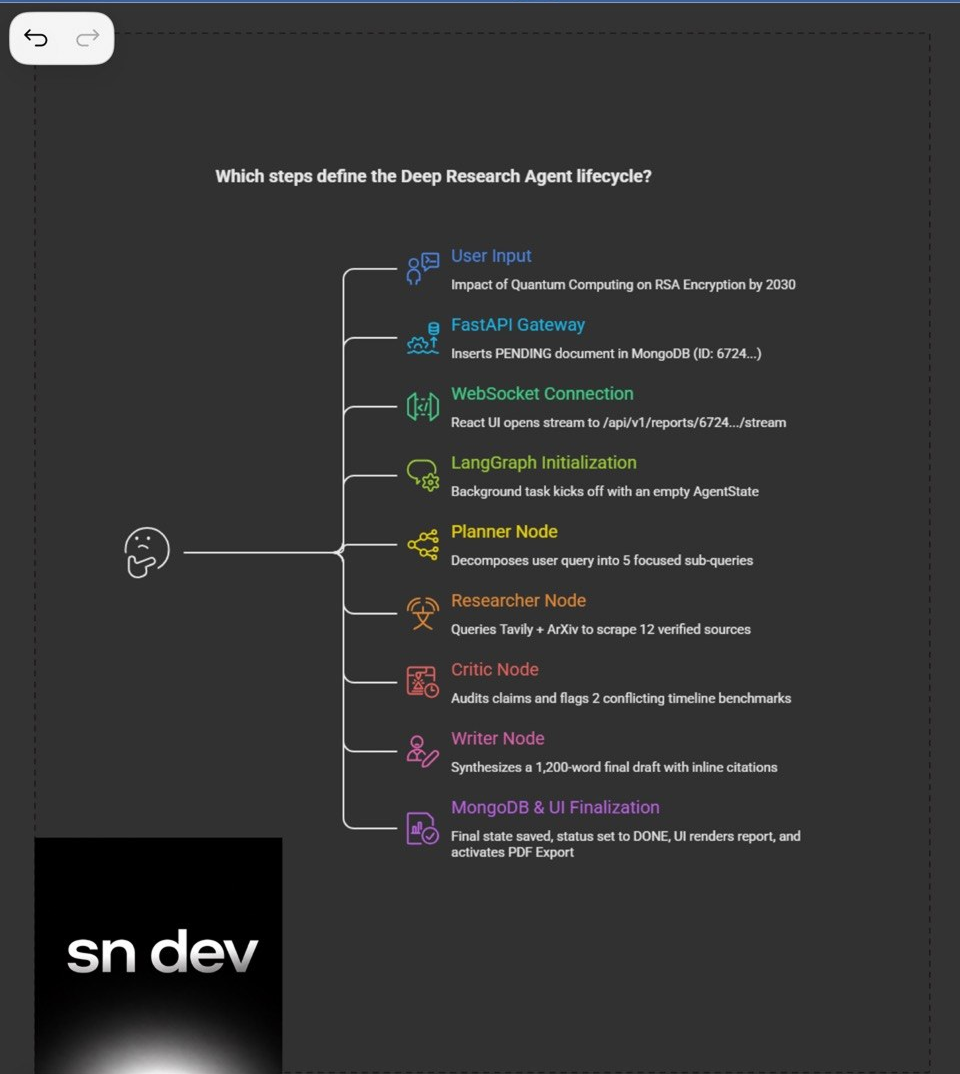
What happens when a user clicks "Search"?
5. The Tech Stack & Architectural Choices
Component | Selected Technology | Why This Choice? |
|---|---|---|
Agent Orchestration | LangGraph | Offers explicit, deterministic control over state machines, schema validation, and conditional cyclic loops (unlike opaque "black box" frameworks). |
Backend Framework | FastAPI (Python) | Native async/await support, Pydantic data validation, native WebSockets, and built-in background tasks. |
LLM Inference | Groq (Llama 3.3 70B) & Google Gemini | Research agents trigger multiple large-context calls. Groq delivers 300+ tokens/sec (reports finish in 10-15s), with automatic failover to Google Gemini. |
Web Search | Tavily Search API | Purpose-built for AI agents; extracts clean markdown and text snippets without ads or cookie popups. |
Academic Retrieval | ArXiv API | Provides peer-reviewed scientific authority, preventing reliance on marketing blogs. |
Database | MongoDB Atlas (Motor Async) | Hierarchical document structure (arrays of sections, citations, conflicts, metadata) fits NoSQL without multi-table relational joins. |
Security Layer | SlowAPI | IP-based rate limiting (financial firewall preventing malicious draining of third-party API credits). |
Frontend | Streamlit / Next.js | Instant interactive dashboards, real-time status feeds, and one-click Markdown/PDF exports. |
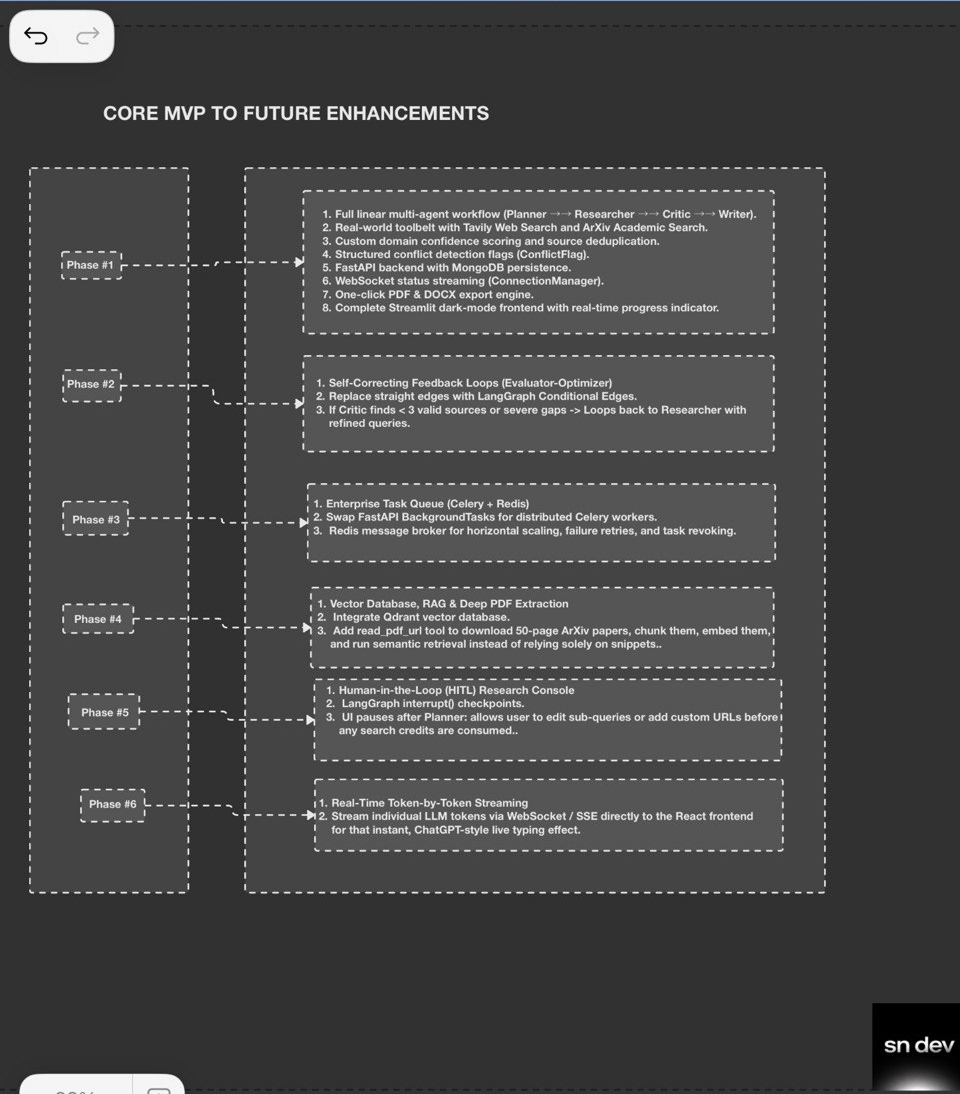
6. From MVP to Future Enhancements: The Master Roadmap
Building production AI requires disciplined iteration. We break our system evolution into 6 clear milestones:
Conclusion & Getting Started
Autonomous Deep Research is not about finding a magic prompt—it is about distributed systems engineering: strict typed memory contracts, deterministic grounding tools, specialized agent roles, and robust asynchronous architectures.
📺 Full Video Breakdown:
If you found this system breakdown valuable, star the repo, subscribe to the channel, and follow along as we code this engine step-by-step!
FastAPI
LangGraph
Gemini
MongoDB
Tavily
Series Navigation
Up Next: Part 2
Continue following "Deep Research Agent" with Setup & Installation for Autonomous Deep Research Agent | End-to-End Agentic AI Project | Part 2.
Community Discussion0
Ask questions, discuss architecture, and share insights with other developers.
Sort:
Sign in to join the discussion and share your thoughts with other developers.
Sign In to CommentLoading discussions…